Rubric-Based Rewards and Reasoning Capacity
A rubric is a structured set of criteria that specifies the requirements for a high-quality response. These criteria may address instruction adherence, constraint satisfaction, the validity of intermediate reasoning, and final-answer correctness. By decomposing response quality into explicit evaluation targets, rubrics support more fine-grained assessment than a single holistic judgment.
In LLM post-training, rubric-based evaluations can serve as reward signals. An evaluator scores policy-generated responses against individual criteria, and the resulting judgments are aggregated into rewards for reinforcement learning. Such feedback can distinguish responses that receive the same outcome-based correctness score. However, greater detail in the evaluation criteria does not necessarily translate into more informative supervision. This raises a central question: can rubric-based rewards extend a model's reasoning capacity, or do they primarily improve the likelihood of generating solutions already accessible to the model?
Reasoning Capacity Beyond the Base Model
Yue et al. (2025) examine this distinction in reinforcement learning with verifiable rewards (RLVR). They use across a range of sampling budgets, including large , to compare RLVR-trained models with their base models. In the settings studied, RLVR frequently improves performance at small , whereas base models can outperform their RLVR-trained counterparts at larger . The authors interpret these findings as evidence that existing RLVR methods primarily improve sampling efficiency rather than introduce fundamentally new reasoning capabilities.
as an Evaluation Metric
measures the probability of obtaining at least one correct response among sampled responses, averaged over evaluation problems. For example, if 60 out of 100 problems have at least one correct response within 16 samples each, the observed is 60%. The metric assesses the availability of a correct solution within the sample set. It does not assess whether the model can select that solution.
Experimental Setup
We follow the SimpleRLZoo-RL experimental setup and adopt the evaluation approach used by Yue et al. (2025). We study a Qwen2.5-7B policy on four mathematical reasoning benchmarks: AIME24, MATH500, Minerva, and Olympiad. We evaluate across increasing sampling budgets, up to on AIME24 and on the other three benchmarks.
We investigate the effects of different rubric generators, judges, and reward designs on post-training performance. We further examine whether the benefits of rubric-based supervision arise from the rubric itself or from access to a stronger model. To investigate this distinction, we compare rubric-based training with conventional distillation and on-policy distillation (OPD), using the same underlying model to provide supervision in each comparison.
The judge is part of the learning signal
In this experiment, we keep the rubric generator fixed and vary the judge model. We use qwen3.7-max as the rubric generator. We then use two separately deployed judges, Qwen2.5-72B-Instruct and Llama-3.3-70B-Instruct, to evaluate policy responses against these rubrics and provide reward signals for training.
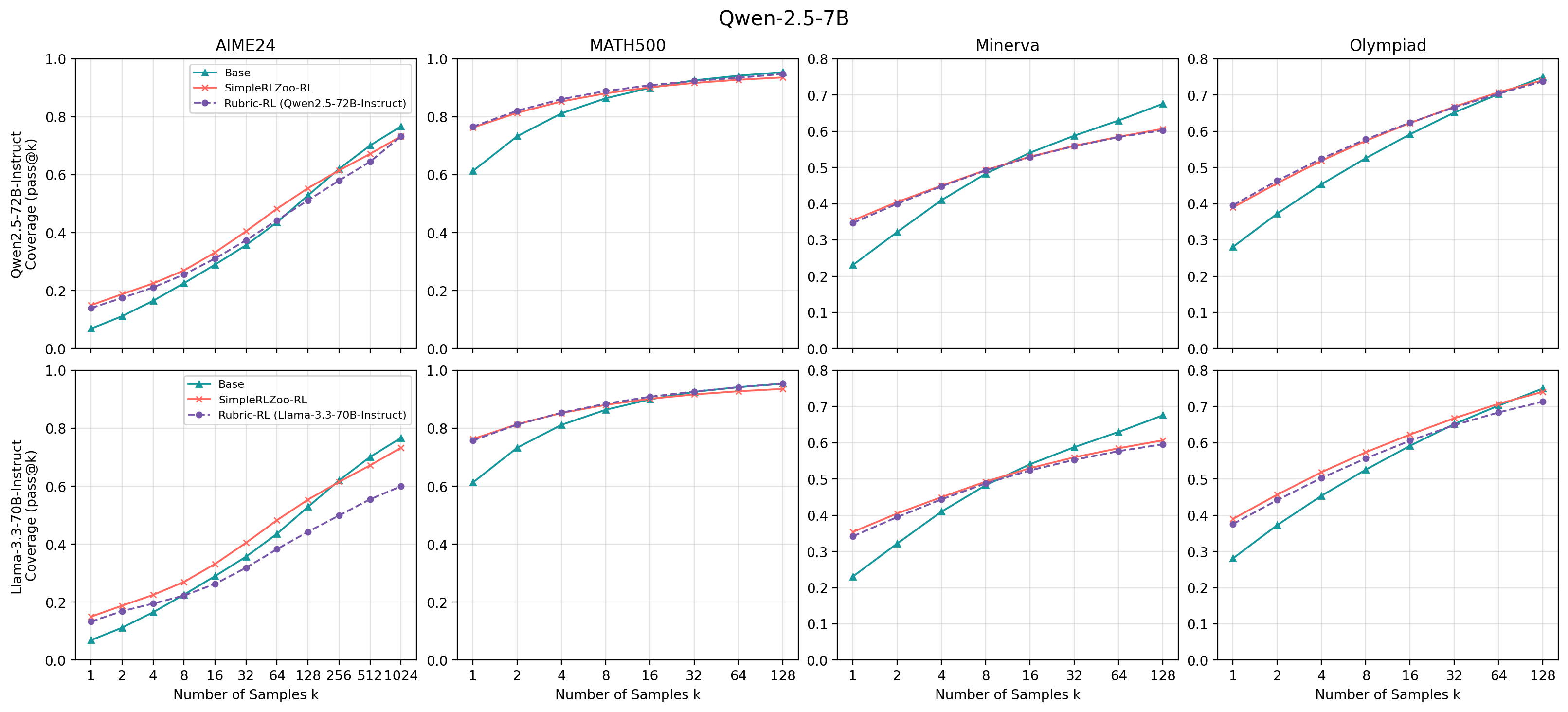
Figure 1 highlights two observations. First, rubric-based RL does not outperform Base overall with either judge model. Second, the choice of judge affects the results. With the Qwen2.5-72B-Instruct judge, the rubric curve remains relatively close to the reference RL curve on AIME24. With the Llama-3.3-70B-Instruct judge, it falls visibly below the reference RL curve at larger sampling budgets. This supports judge dependence. A plausible explanation is that differences in how judges interpret the rubric criteria affect which rollouts receive higher rewards.
Because the rubric generator and judge are different models in this setup, their evaluation preferences may not align. We therefore investigate whether using the same model for both roles improves the results by reducing this potential mismatch.
Does using the same model for both roles help?
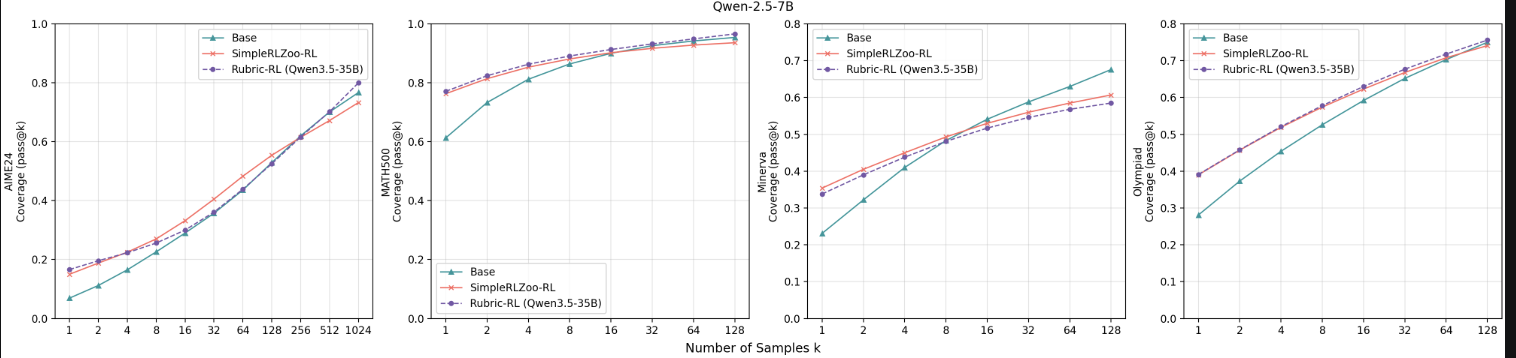
We use the same model, Qwen3.5-35B-A3B, for both rubric generation and judging. This yields encouraging results, with the resulting policy outperforming both Base and reference RL on AIME24, MATH500, and Olympiad. Yet Minerva still has lower high-budget coverage than Base. The result is promising on some tasks, not a universal recovery of coverage. My interpretation is that agreement between the generator and judge may help make criteria actionable.
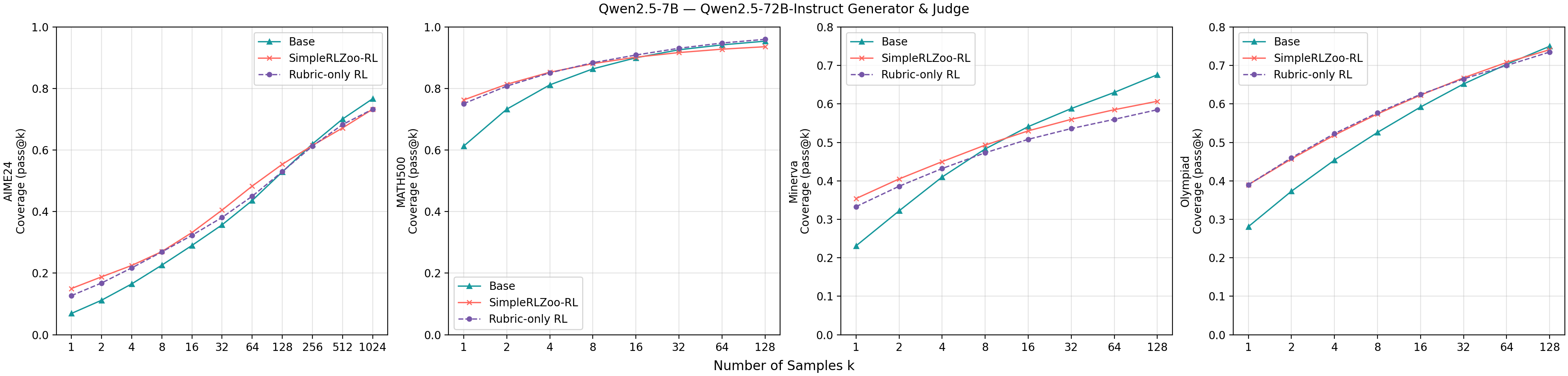
We repeat the shared-generator-and-judge setup using Qwen2.5-72B-Instruct. At the largest evaluated sampling budgets, it exceeds both Base and reference RL on MATH500, matches reference RL on AIME24, and remains below Base on AIME24, Minerva, and Olympiad. These results show that the choice of model also matters.
Correctness plus a rubric is not a guaranteed win
To investigate whether reward design affects the results, we introduce an alternative reward formulation that keeps correctness as the anchor and uses the rubric as an auxiliary signal. We test the following form:
If exact correctness is binary and the rubric score is normalized to , a correct answer always receives a higher total reward than an incorrect one.
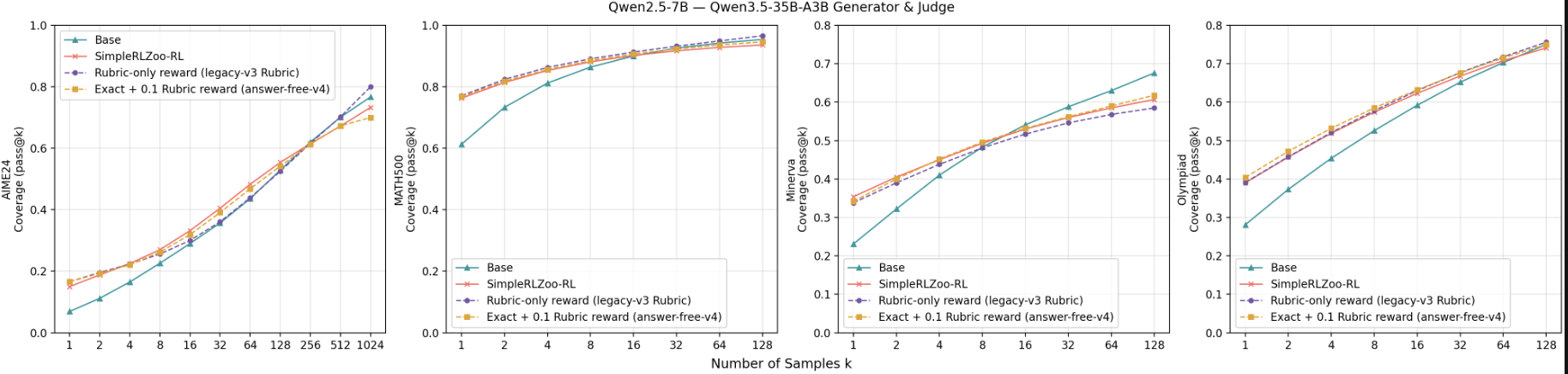
For the Qwen3.5-35B-A3B configuration, the hybrid reward underperforms the rubric-only reward on AIME24, MATH500, and Olympiad. On Minerva, the hybrid reward improves over rubric-only training, but its high-budget coverage remains below Base.
One possible explanation is that the rubric already includes an answer-correctness criterion. Adding a separate correctness reward may therefore double-count this signal, while scaling the rubric score by 0.1 reduces the relative contribution of its other criteria. This could shift the learning signal toward final-answer correctness and weaken the influence of the broader feedback provided by the rubric.
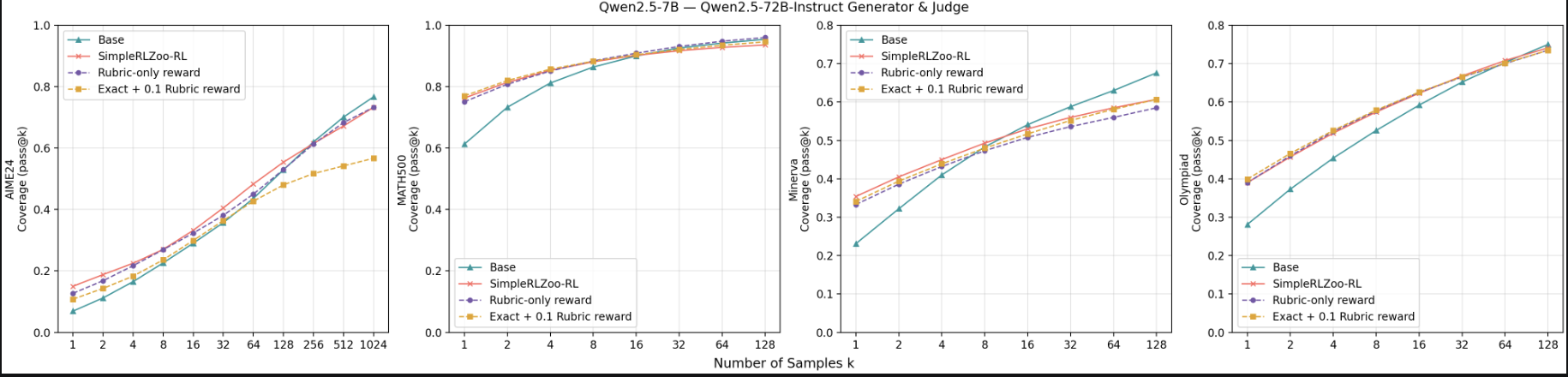
To examine whether this finding holds with a different model, we use Qwen2.5-72B-Instruct for both rubric generation and judging. The results again show that the hybrid reward does not consistently improve over rubric-only training, with substantially lower coverage on AIME24 at large . This suggests that adding an apparently sensible auxiliary reward can still change exploration or credit assignment in an unfavorable way.
Giving correct answers higher rewards is a useful scoring property. However, as these experiments illustrate, it does not guarantee that policy optimization will improve every benchmark or preserve every rare solution.
Rubrics, distillation, and self-generated feedback
We first compare rubric-based RL with conventional distillation through supervised fine-tuning (SFT). In this baseline, a teacher model generates responses to the training problems, and the student model is fine-tuned on these teacher-generated responses. We use Qwen3.5-35B-A3B as the teacher for SFT and use the same model as both the rubric generator and judge in the rubric-based RL comparison. The results are shown below.
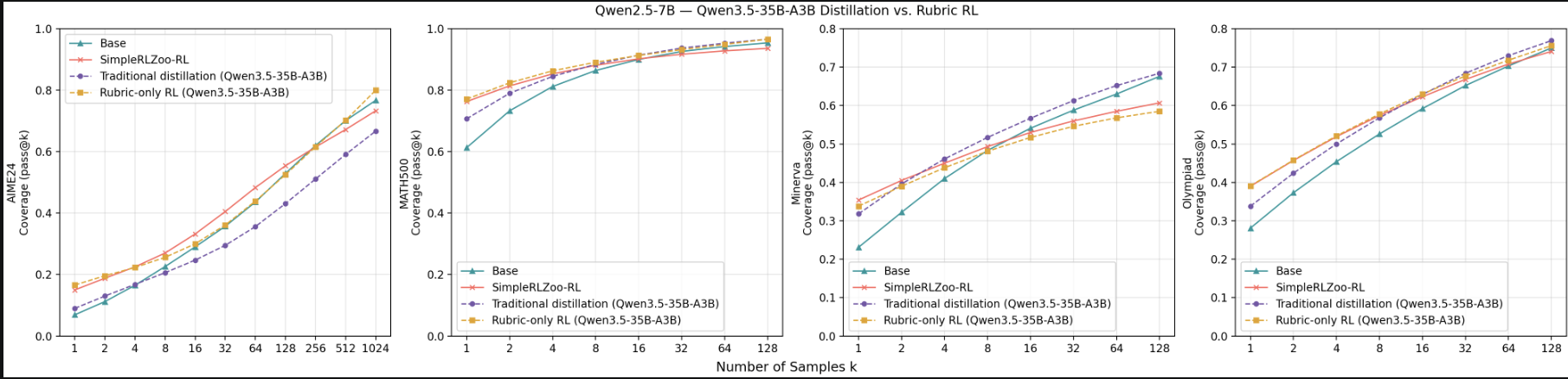
Overall, these results suggest that conventional distillation can expand the model's reasoning capability frontier. It outperforms both the Base model and rubric-based RL on MATH500, Minerva, and Olympiad.
We also compare rubric-based training with on-policy distillation (OPD). In standard token-level OPD, directly matching teacher and student distributions requires aligned tokenization and vocabulary indices. For this comparison, we use Qwen2.5-72B-Instruct as the teacher for the Qwen2.5-7B student, keeping both models within the Qwen2.5 family. The teacher provides token-level supervision on student-generated trajectories. A rubric describes what to value, whereas token-level distillation teaches a distribution over continuations.
For a direct comparison using the same supervisory model, Figure 7 includes rubric-only RL with Qwen2.5-72B-Instruct as both generator and judge, alongside OPD with the same teacher, Base, and reference RL.
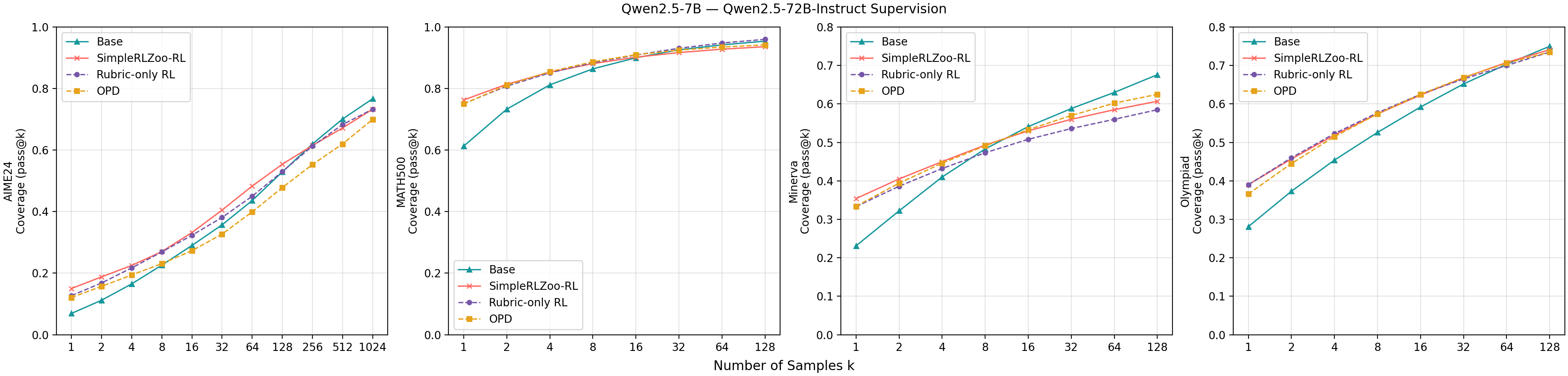
With the same supervisory model, the relative performance of rubric-only RL and OPD varies across benchmarks. At the largest evaluated sampling budgets, rubric-only RL achieves higher pass rates on AIME24 (73.3% versus 70.0%) and MATH500 (96.0% versus 94.2%). OPD performs better on Minerva (62.5% versus 58.5%), while both reach 73.5% on Olympiad. These results suggest that how a teacher provides supervision matters, even when the teacher model is held fixed.
Overall, the experiments with Qwen3.5-35B-A3B as both rubric generator and judge show improvements over Base on most benchmarks, although conventional distillation through SFT performs better on three of the four benchmarks. Using Qwen2.5-72B-Instruct yields less favorable results overall, but rubric-only RL still outperforms OPD on AIME24 and MATH500 at the largest evaluated sampling budgets. My interpretation is that some of the capability gains from rubric-based RL may come from the capabilities of the model that generates and judges the rubrics.
Do Rubrics Help Without a Stronger Teacher?
This leaves an open question about the contribution of the rubrics themselves. To investigate it, we conduct a self-generated rubric experiment in which the policy model itself serves as both rubric generator and judge, with both roles evolving alongside the policy during training.
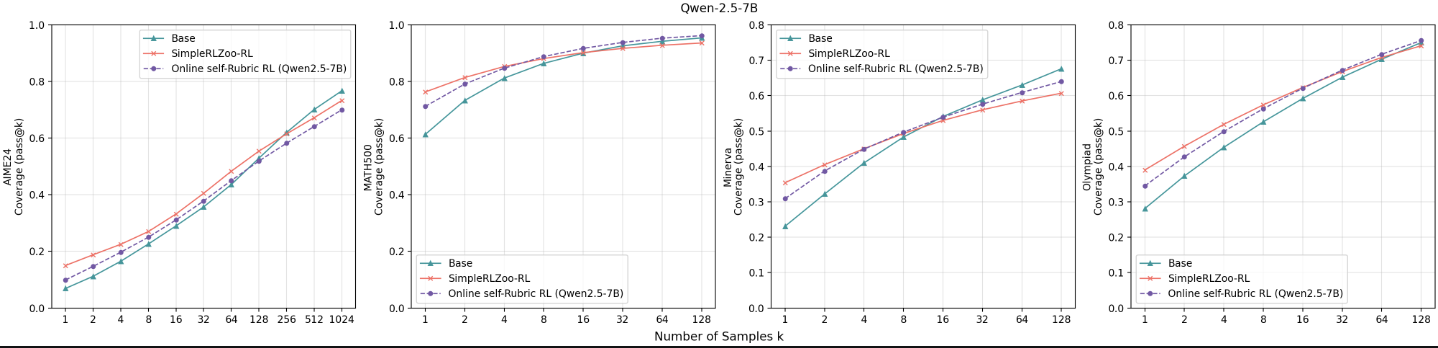
The online self-rubric experiment shows encouraging MATH500 and Olympiad trends.
What I would conclude
| Experiment | Conclusion |
|---|---|
| Fixed rubric generator with different judges (Figure 1) | Changing the judge changes the learned policy's performance, showing that the judge is an important part of the reward signal. |
| Qwen3.5-35B-A3B as both generator and judge (Figure 2) | Using a shared generator and judge is promising, although this experiment also changes the model identity. |
| Qwen2.5-72B-Instruct as both generator and judge (Figure 3) | The shared-model setup performs less favorably overall than the Qwen3.5 configuration, indicating that model choice remains important. |
| Rubric-only versus hybrid rewards (Figures 4–5) | Adding answer correctness to the rubric reward does not consistently improve performance. |
| Rubric-based RL versus SFT distillation (Figure 6) | With Qwen3.5-35B-A3B supervision, SFT distillation exceeds both Base and rubric-based RL on MATH500, Minerva, and Olympiad. |
| Rubric-based RL versus OPD with the same teacher (Figure 7) | At the largest evaluated budgets, rubric-only RL leads on AIME24 and MATH500, OPD leads on Minerva, and they tie on Olympiad. The form of supervision matters even with a fixed teacher. |
| Policy-generated rubrics and self-judging (Figure 8) | The MATH500 and Olympiad trends suggest that self-generated rubric feedback can be useful without a stronger external teacher, motivating further work on jointly improving the policy and its feedback. |
My main takeaway is that both the capabilities of the supervisory model and the way its feedback is structured matter for the reasoning capability frontier reached through RL. The comparisons suggest that an external model contributes part of the learning signal, while rubric-based rewards can make that signal useful for learning and support capability gains on some tasks. The self-generated rubric results further motivate exploring whether a policy can improve the criteria it generates and applies as it learns. One direction is to jointly optimize rubric generation, judging, and policy learning over repeated iterations. This could inform future approaches to recursive self-improvement (RSI).
Text rubrics also offer a potential practical advantage. They can be reused across rollouts and obtained through text-only APIs, whereas logit-based OPD requires access to the teacher's token distributions. This may reduce the cost of obtaining supervision, although the experiments here do not quantify that advantage. Together with their task-specific learning benefits, this flexibility makes rubric-based rewards a promising direction for post-training.
Further reading
Background reading: Yang Yue et al., Does Reinforcement Learning Really Incentivize Reasoning Capacity in LLMs Beyond the Base Model? (2025).